What is Positive Water Impact (PWI)?
PWI is a leadership vision set at the enterprise level and is available to any company, across any sector, industry or geography. It is a flexible framework, supporting corporates to ensure that the water user’s contributions towards a healthy basin exceed their impacts, building long-term resilience in water-stressed basins.
PWI is designed around a long-term commitment and provides input towards quantifiable outcomes. PWI is structured into three pillars that help define the scale of activities for each site. Each pillar addresses multiple dimensions of water stress, namely availability, quality and accessibility. PWI aligns with other corporate water stewardship approaches and supports SDG 6.
Importantly, PWI positions water stewardship as an ongoing journey, not a destination.
Evolving from NPWI to PWI
The CEO Water Mandate and Water Resilience Coalition (WRC) are reframing the Net Positive Water Impact (NPWI) ambition as the Positive Water Impact (PWI) vision.
This change was made to remove a perceived barrier, mischaracterizing water stewardship as a compliance-driven exercise, instead inviting innovation and collaboration, resulting in context-specific impact. The reframing to PWI opens the scope of the framework so that an aspirational end goal is not a barrier for companies to begin their stewardship journey.
The updated framework not only maintains the same scientific rigor of the guidance while better reflecting a dynamic, collaborative, and science-based approach to water stewardship, but also better aligns with how companies operate, plan, and invest, enabling more scalable and meaningful corporate action.
*Note: Please note that some legacy resources and historical documents may still bear the former name (NPWI). Moving forward, all new materials will reflect the updated name, PWI.
To learn more about this evolution, please read, Reframing NPWI: A Strategic Evolution Toward Positive Water Impact (PWI)
Contributions to PWI development
PWI is a concept that has taken several years to evolve. Several companies and consultancies have supported the development of the original conceptual framework, helped draft principles, and reviewed drafts of the guidance. Companies and those that use the guidance to implement PWI are encouraged to continue to engage with the CEO Water Mandate, Pacific Institute and the PWI Task Force of member organizations from the WRC to continue adapting and improving the contents of the guidance and help inform the strategic direction of this work.
Support Offered for PWI Implementation
The CEO Water Mandate aims to facilitate a wide uptake of PWI. To this end, it offers different levels of support to companies and consultants interested in PWI implementation. PWI Tier support
To support organizations on their PWI implementation journey, the WRC and CEO Water Mandate jointly offer tiered support options to companies and consultants, ranging from self-guided learning to bespoke implementation assistance.
Support Offered for PWI Implementation
For those seeking a foundational understanding of PWI.
• Availability: Open to all
• Cost: Free
• How we engage: The PWI website hosts support materials. For further inquiries, contact the CEO Water Mandate via email. Limited written and phone support is available.
• What we offer: Includes access to PWI FAQs, key presentations from major events, and a series of recorded instructional presentations that delve into the five PWI steps outlined in the Technical Guidance. Additionally, resources are provided to explain the link between PWI and the 100 Basins App. Materials will remain accessible on the website and will be updated regularly.
• Availability: Exclusive to the CEO Water Mandate endorsing companies and members of the Water Resilience Coalition.
• Cost: Included in endorsement/membership fees
• Engagement: PWI implementation support and insight sharing through quarterly small group engagements and online workshops will be enabled. Limited individual email and phone support is available. Members and endorsers with notable lessons or progress may be invited to share their experiences on platforms such as Stockholm World Water Week and the United Nations General Assembly. Additionally, PWI Task Force meetings for WRC members provide the opportunity to inform the strategic direction and evolution of PWI.
• What we offer: The small group engagements will cover general support, PWI tips and tricks, and opportunities for facilitated co-learning on PWI topics.
o Best practices for stakeholder engagement and collective action
o Setting effective targets and objectives
o Quantifying the three dimensions of water stress using the detailed Step-in-Practice guide
o Designing robust monitoring and evaluation plans
o Understanding optional validations and claims processes
o Scaling PWI across organizations
• Availability: For companies seeking intensive, bespoke support
• Cost: Approximately US$30,000 per company, to support PWI implementation at up to three sites
• Engagement: Tailored support will be offered through online meetings (monthly/bimonthly check-ins) and in-person workshops (where possible) tailored to the specific needs of the company. The anticipated duration of support is approximately 12 months, with flexibility to adjust the timeline as needed.
• What we offer: The CEO Water Mandate will offer support in the form of strategy review, implementation advice, and workshop facilitation. This support is different from operational implementation, which is typically handled by third-party consultants. Tier 4 specifically addresses the needs of consultants and practitioners seeking support in their roles. The content would be tailored to the specific needs of the company. It could include:
o Strategic guidance: Embedding PWI across the organization to provide the foundation for a new/revised water strategy.
o Technical assistance: Reviewing and advising on baseline data collection, target setting, and action selection (Steps 3 and 4 of PWI).
o Data management: Supporting the data setup in the Internal Tracking Framework (ITF) or other internal dashboards by helping with the review of first-time data entries.
o Stakeholder engagement: Facilitating the stakeholder mapping for Pillar 3, and initial workshops.
o Communication and reporting: Assisting with communicating progress and achievements in Step 5.
This tier is specifically directed at third-party consultants and practitioners who support corporations on the PWI journey. The goal of this tier is to provide PWI training to ensure a consistent understanding of the approach and guidance and offer standardized support to companies through these third-party providers.
• Availability: This tier is available to consultants, practitioners, NGOs, global UNGC country networks, and other organizations that plan to support PWI implementation or scaling.
• Cost: The training course fees are US$ 1000 per person. Consultants can join our recommended service provider list once a current staff member has completed the course and demonstrated proficiency. This person should be the lead on the project supporting PWI work. There will be a nominal annual fee per organization to maintain this list and provide relevant updates and information. Contact us for reduced-cost/no-cost options for NGOs, strategic partners, and UNGC country networks.
• Engagement: Online training workshops, access to implementation-support materials and resources, and engagements at global events.
• What we offer: It is anticipated that there will be two training courses annually, providing in-depth training on the PWI guidelines. Each training will be concluded over one month and include:
o An introductory online webinar
o A set of online lessons to work through in your own time
o An FAQ online webinar
o An open-book assessment
o Key workshop topics will include PWI introductions, technical steps and implementation, alignment with other CWS approaches, validation, claims, and other relevant subjects. These sessions are designed to equip third-party consultants and practitioners with the knowledge and skills needed to deliver consistent and high-quality support to corporate clients.
PWI Guidance
The following working documents provide guidance for the PWI journey.
Executive Summary
The Executive Summary provides a high-level overview for decision-makers and executives to understand the PWI vision and implementation steps.
Positive Water Impact: An Introduction
Positive Water Impact: An Introduction offers a comprehensive introduction to the objectives, value and structure of PWI, providing the entry point to the PWI guidance and suitable reading for corporate leadership and technical staff. This document also captures the evolution of PWI from concept to current thinking.
Implementing Positive Water Impact: Technical Guidance
Implementing Positive Water Impact: Technical Guidance is an in-depth description of the required steps across the three pillars of PWI and multiple dimensions of water stress.
Implementing Positive Water Impact: Step-in-Practice
Implementing Positive Water Impact: Step-in-Practice provides a hypothetical example for operationalizing PWI in the textile industry and is intended as a practical add-on to the technical guidance document.
Upcoming Resources:
The Internal Tracking Framework (ITF)
The Internal Tracking Framework (ITF) includes all indicators and other metrics to enable standardized data collection and progress reporting.
Positive Water Impact in Resilient Value Chains
This guidance component will expand PWI implementation from direct operations into corporate value chains. Specific effort is made to align this guidance to other value chain work in the water stewardship space. This guidance is upcoming and is anticipated to be launched in late 2026.
Understanding Positive Water Impact (PWI): FAQ
For more information, see section "Differentiating Net Positive Water Impact from other water positive terms" in the Positive Water Impact: An Introduction.
There are three distinct “Pillars” that define the scale at which PWI is being addressed. Each Pillar addresses the three dimensions of water stress across different scales.
• Pillar 1: Undertaken at the site level. The property in which all operations occur. Examples can be a farm, a factory, a complex or campus with multiple buildings.
• Pillar 2: Undertaken at the site to sub-basin level. Includes company site premises and/or areas (e.g., wetlands, rivers) within the vicinity of the site, at the sub-basin level. It should span most employee households, to address accessibility.
• Pillar 3: Undertaken at the sub-basin/basin level. A collectively defined local basin level, at which all three dimensions can be meaningfully addressed in collective action.
For more information, see section “What is Positive Water Impact” in the Positive Water Impact: An Introduction.
PWI focuses on multiple dimensions of water stress:
• Water Availability: Aims to reduce the volume of water withdrawn from the basin over time, through minimized withdrawals at the site and replenishing volumes to balance the site’s water footprint, with long-term basin outcomes.
• Water Quality: Focuses on reducing and eventually eliminating the pollutant load at the site, downstream and in the basin, measured by reductions in mass or volume of pollutants per year.
• Water Accessibility: Seeks to improve access to water, sanitation, and hygiene (WASH) services for employees and the population within the basin, ensuring these services are climate-resilient and safely managed.
For more information, see section “What is Positive Water Impact” in the Positive Water Impact: An Introduction.
Working towards PWI for water availability
Ideally, any replenished water should be returned to the same water body from which it was withdrawn.
• For P2 Replenishment can occur either upstream (preferably) or downstream but must remain within the spatial area defined for P2. Restoration projects may take place outside the immediate vicinity if they ultimately contribute water flow back into the sub-basin.
•For P3 Replenishment to a different water body is acceptable, provided it remains within the same basin.
Most companies are unlikely to reach full PWI for availability under P1 and P2, as replenishment and restoration efforts typically occur outside the immediate site area. As long as replenishment remains within the same basin, ideally as far upstream as possible, it is considered acceptable.
• Within the same spatial area for P2, and
• Within the same basin for P3.
All decision-making related to replenishment choices should be well documented. When in doubt, consult the CEO Water Mandate for guidance.
Companies should, as much as possible, replenish water in the basin where it originates, including in cases of interbasin transfers. If the water supply draws from multiple basins, consider either:
• A proportional replenishment effort across the contributing basins
• Prioritizing replenishment in the most water-stressed basin first
In all cases, document the rationale behind replenishment decisions to ensure transparency and accountability.
PWI Goals and Impact
The primary aim of PWI is to drive significant and long-term improvements in the health and resilience of water basins. PWI focuses on addressing the fundamental issues affecting water availability, quality and accessibility. By targeting these dimensions of water stress, PWI aims to create sustainable solutions that enhance the overall health of water systems and ensure their resilience against future challenges.
The primary aim of PWI is to drive significant and long-term improvements in the health and resilience of water basins. PWI focuses on addressing the fundamental issues affecting water availability, quality and accessibility. By targeting these dimensions of water stress, PWI aims to create sustainable solutions that enhance the overall health of water systems and ensure their resilience against future challenges.
PWI requires companies to go beyond merely balancing their operational water use. It calls for a proactive approach in which businesses actively contribute to the restoration and improvement of the basins where they operate. This involves engaging with local stakeholders, investing in strategic initiatives and implementing practices that directly address the specific water challenges faced by each basin.
PWI seeks to ensure that the positive contributions made by companies exceed their water-related impacts, particularly in water-stressed regions. Through this ambitious approach, PWI not only supports the sustainability of water resources but also aligns with broader environmental and social goals, contributing to the well-being of communities and ecosystems.
For more information, see section “What is Positive Water Impact” in the Positive Water Impact: An Introduction.
PWI supports companies by offering a structured approach to integrate water stewardship into their business goals and priorities. PWI is designed to build long-term resilience in water-stressed basins by addressing water insecurity across all dimensions—availability, quality, and accessibility—through both on-site and collaborative efforts. For companies with existing water-related objectives, PWI can align and enhance these goals, ensuring a comprehensive approach to water stewardship. For others, PWI can serve as a foundational framework to develop new strategies and targets.
By incorporating PWI into their business strategies, companies can take a more strategic and integrated approach to managing their water impact. This integration requires involvement at the enterprise level, ensuring that top decision-makers understand and commit to the necessary actions for effective implementation. PWI encourages companies to assess their current water practices, identify gaps and develop or refine policies to meet PWI's ambitious targets.
PWI facilitates the alignment of corporate water stewardship with broader business objectives, promoting a unified approach across different teams and departments. By embedding PWI principles into their operational strategies and decision-making processes, companies can demonstrate leadership in sustainable water management, enhance their reputation and drive significant improvements in water resilience and impact.
For more information, see section “Integrate PWI into company business goals and priorities” in the Implementing Positive Water Impact: Technical Guidance.
PWI Guidance Structure
The PWI guidance is split into several documents, making it easier to pair the level of detail with the respective user.
- The Executive Summary provides a high-level summary for decision-makers and executives to understand the PWI vision and implementation steps.
- Introducing Positive Water Impact offers a comprehensive introduction to the objectives, value and structure of PWI, providing the entry point to the PWI guidance and suitable reading for corporate leadership and technical staff.
- Implementing Positive Water Impact: Technical Guidance provides an in-depth description of the required PWI steps across three Pillars and three dimensions of water stress. It forms the core reading to guide a company through PWI implementation at the site and basin scales in water-stressed basins.
- Implementing Positive Water Impact: Step-in-Practice provides a practical example for operationalizing PWI in the textile industry and is intended as an add-on to the technical guidance document.
Upcoming resources include:
- The Internal Tracking Framework (ITF) includes all indicators and other metrics to enable standardized data collection and progress reporting.
- Positive Water Impact in Resilient Value Chains component will expand PWI implementation from direct operations into corporate value chains. Specific effort is made to align this guidance to other value chain work in the water stewardship space. This guidance is upcoming and is anticipated to be launched in late 2026.
The PWI call to action urges companies operating in water-stressed basins to integrate and implement the PWI framework comprehensively across their operations. This involves several key steps: firstly, formulating a clear PWI vision at the enterprise level to guide overall water stewardship strategies. Secondly, prioritizing the implementation of PWI across all high-priority sites to address the most critical water stress issues effectively.
Further, companies are encouraged to extend PWI implementation to all their water-stressed sites, ensuring that every location contributes to the overarching water resilience goals. Additionally, the call to action emphasizes the importance of informing other companies, particularly those within the same basin and supply chains, about PWI. Lastly, companies are encouraged to support other organizations in their PWI journey, fostering a collaborative approach to enhance water stewardship across the industry.
In addition to these steps, the PWI framework encourages ongoing engagement with evolving guidance materials and practices. Companies should stay informed about updates to PWI guidance, such as the addition of new dimensions of water stress or technical guidelines, to ensure their practices remain cutting-edge and aligned with best practices. By actively participating in the PWI community and promoting continual learning and adaptation, companies can help drive a broader, more impactful shift towards sustainable water management globally.
For more information, see section “Next steps and call to action” in the Implementing Positive Water Impact: Technical Guidance.
The PWI guidance is a dynamic and evolving framework that will continue to be updated based on lessons learned, emerging methodologies, and stakeholder feedback. Future developments include the potential addition of biodiversity as a fourth dimension of water stress, technical guidelines for implementing PWI across supply and value chains, and alignment with other water stewardship frameworks such as SBTN. The WRC and its members are encouraged to participate in the ongoing refinement of PWI materials, ensuring that the guidance remains relevant and effective in addressing global water challenges. As PWI evolves, it will continue to align with broader corporate water stewardship approaches to support comprehensive and integrated water resilience strategies. The CEO Water Mandate encourages those engaging with PWI to help shape the future iterations of this work and ask for candid feedback to improve the guidance.
For more information, see section “Next steps and call to action” in the Implementing Positive Water Impact: Technical Guidance.
Corporate Engagement and Communication
PWI itself is not a formal commitment but rather a strategic vision that companies can choose to adopt. Companies have the option to consider PWI for internal strategic purposes, treating it as a guiding principle or "North Star" for their water stewardship goals. Alternatively, they can choose to make their PWI vision highly visible and formalize it publicly, thereby demonstrating a strong dedication to water sustainability and potentially enhancing their brand value and credibility.
A PWI vision is voluntary and not legally binding. Companies have the flexibility to adjust their approach or even opt out of their PWI goals if needed. However, it is important to note that PWI is designed to align with long-term water stewardship and sustainability objectives, and companies are encouraged to stay the course to achieve meaningful impact in water-stressed basins. While there is no formal requirement to maintain the PWI vision, opting out may affect the company's reputation and perceived commitment to water resilience and sustainability.
NPWI itself is not a formal commitment but rather a strategic ambition that companies can choose to adopt. Companies have the option to use NPWI for internal strategic purposes, treating it as a guiding principle or "North Star" for their water stewardship goals. Alternatively, they can choose to make their NPWI commitment highly visible and formalize it publicly, thereby demonstrating a strong dedication to water sustainability and potentially enhancing their brand value and credibility.
For more information, see the Implementing Positive Water Impact: Technical Guidance.
Companies have a range of options for communicating their PWI progress. Internal communication is strongly encouraged and involves updating department heads, organization leaders or boards, or through internal channels like newsletters. This helps keep internal stakeholders informed and engaged with the company’s water stewardship efforts. Transparent internal communication is key to demonstrating progress and maintaining accountability within the organization.
Public commitments and reporting on PWI progress are voluntary. Companies can choose whether to make their PWI visions and milestones public. If a company opts for public disclosure, it is highly encouraged to have any statements of PWI achievement validated by an independent third party. This ensures that the company’s claims are credible and align with broader efforts to promote transparency in corporate water stewardship.
While it is not required for companies to publicly commit to or report on PWI outcomes, such actions can be beneficial. Public reporting can enhance the company’s reputation, demonstrate leadership, and encourage collaboration with other stakeholders. Companies that choose to communicate their PWI progress publicly should ensure that their data is accurate and validated to support credible reporting and avoid misleading stakeholders.
For more information, see section “Report and communicate outputs and outcomes” in the Implementing Positive Water Impact: Technical Guidance.
The CEO Water Mandate is dedicated to supporting companies throughout their PWI journey by offering a proposed tiered support approach. This support is designed to guide companies through the various steps involved in achieving PWI, ensuring a comprehensive and effective implementation process.
| Tier 1 | Tier 2 | Tier 3 | Tier 4 | |
| Who is this for | PWI for all | PWI for WRC and paying CEO WM endorsers | PWI paid support package (up to three sites) | Consultants and Global Networks |
| Nature of engagement | Access to prepared resources – not individualized | Small group engagement | Individualized support | PWI Training |
| Communication opportunities | Website, emails, limited number of calls | Emails, calls, online workshops | Online support In-house workshop Monthly-bi-monthly check-ins | Online training workshops |
| Services offered | Available online:
- FAQ section - Variety of videos with information, guidance - e.g., 10-minute videos for each PWI step - PWI milestones and claims process - Basin impact: data aggregation for 100 priority basins. - Lesson sharing among companies - video |
Online tips and tricks sessions one every quarter:
- Best practices stakeholder engagement and collective action - How to set up targets and objectives - How to quantify 3 dimensions (SIP) - How to design a M&E plan - Validations and claims - Scaling PWI - Facilitated co-learning opportunities among corporates - Engagement platform opportunities for milestone achievers |
- Embedding PWI across organization through webinar (to be recorded and shared). Can result in new/revised water strategy.
- Support in data collection - Support & review in target setting, activity selection, etc. - Review of setting up ITF processes. - Support with stakeholder mapping, first contact and facilitation. - Support in communicating progress and achievements. |
Train the trainer program - online |
| Support timeline | Ongoing | Ongoing - Four online quarterly events per annum, regular Task Force meetings plus extra engagement events annually (UNGA, SWWW etc.) | Up to 1 year | Feb 2025 – annual repeat |
For more information, read the Implementing Positive Water Impact: Technical Guidance.
Claims and Validation
We are currently adapting the PWI validation and claims processes in consultation with the PWI Task Force members and external organizations developing similar processes. For now, validation in the PWI journey is recommended once a company wants to make a formal PWI claim of a milestone achievement (e.g., achieving PWI for one dimension across a pillar) or a full claim, typically after several years of implementation. The validation process is not mandatory, but is highly recommended to ensure that the claims made by companies are accurate, robust and transparent. We recommend contacting the authors of the PWI guidance for more information, as this is an evolving area and may change over time.
For more information, see section “Report and communicate outputs and outcomes” in the Implementing Positive Water Impact: Technical Guidance.
1. Regular progress reporting against minimum PWI requirements and internal progress targets: Companies can use the Internal Tracking Framework (ITF) to systematically track their progress towards PWI over time. This framework facilitates the standardized, consistent collection and reporting of data related to water stewardship efforts and milestones and requires biannual or annual updating.
2. Internal Tracking Framework (ITF): Reporting through the ITF can make tracking PWI progress easier by offering a standardized platform for companies that do not have internal dashboards or data-entry systems.
Data Security and Privacy: The ITF is part of the 100 Basins app, which adheres to stringent security measures.
For more information, see section “Analyze and evaluate outputs and outcomes with recommended indicators” in the Implementing Positive Water Impact: Technical Guidance.
PWI and other Corporate Water Stewardship Approaches
• SDG 6.1 to 6.6 Targets: PWI directly supports targets related to clean water access, sanitation, water quality, water management and ecosystem restoration, reinforcing global efforts to achieve Sustainable Development Goal 6. By addressing these specific targets, PWI helps organizations contribute to the comprehensive goals of SDG 6.
• Alliance for Water Stewardship (AWS) Standard: While the AWS Standard provides a robust framework for water stewardship at the site level, PWI expands this focus to include both site and basin levels. This broader scope allows PWI to address more complex water challenges and provides a more integrated approach to water management.
• Benefit Accounting Frameworks: PWI complements existing and emerging benefit accounting frameworks by offering a structured methodology for evaluating and reporting water impacts. It helps organizations track progress and quantify benefits related to water stewardship, thereby integrating with broader environmental, social and governance (ESG) reporting.
• Science Based Targets Network (SBTN) Freshwater Method: PWI aligns with the SBTN Freshwater Method by incorporating science-based targets and site-specific water management strategies. It provides a practical approach for implementing freshwater targets at both local and basin levels, enhancing the effectiveness of SBTN’s science-based recommendations.
CSRD Standard: PWI has significant alignment with the water-related components of the CSRD standards. CSRD gives PWI a standardized disclosure framework, while PWI gives CSRD a standardized framework for action. For a more detailed crosswalk click here.
• Global Tools: PWI integrates with global tools such as the Water Risk Filter and Aqueduct, which provide valuable insights into water risks and opportunities. By aligning with these tools, PWI helps organizations better understand and manage water-related risks on a global scale, improving their overall water stewardship strategies.
Overall, PWI acts as a unifying framework that not only aligns with but also enhances the functionality of various water stewardship tools and approaches. Its comprehensive approach to addressing water stress across multiple dimensions makes it a valuable addition to the existing ecosystem of water management practices.
For more information, see sections "Positive Water Impact and the Sustainable Development Goals” and “Alignment between PWI and other water stewardship tools, approaches and frameworks” in the Positive Water Impact: An Introduction
.Partnerships are crucial in PWI investments, especially at the basin scale and some site-level projects. Establishing partnerships with organizations that have relevant experience, and proven capacity ensures that activities are implemented effectively and provides access to technical expertise and local networks. To formalize these collaborations, a written agreement could be established, outlining credit allocation, progress reporting methods and frequencies, and public communication strategies regarding project outputs and outcomes.
In collective action initiatives, sharing credit for collaborative investments is essential. According to the VWBA Guide 2.0, companies must apply credible and transparent approaches for attributing volumetric water benefits (VWBs). Key considerations for attribution include:
• Consensus Among Parties: All parties involved, including the company making the claim, other project sponsors, and project implementers, should agree on the attribution approach based on a shared understanding of the costs, funding sources, and resulting VWBs.
• Proportional Attribution: VWBs should be attributed in proportion to each company's contribution to the project. This can be based on monetary contributions, in-kind support, or leading roles in the project.
• Cost-Share Approach: When the total project cost and expected outputs are clear, VWBs can be attributed using a cost-share approach, where each sponsor's share of VWBs reflects their proportional financial contribution.
In cases where credible attribution methods are challenging to determine, engaging subject-matter experts and consulting external stakeholders can help ensure that the approach minimizes the risk of overclaiming and supports transparent, fair and accountable claims. This is crucial to prevent greenwashing, double counting or over-claiming outcomes and to maintain the integrity of PWI initiatives.
For more information, see section “Establish and secure inputs needed for financing and partnerships” in the Implementing Positive Water Impact: Technical Guidance.
How Positive Water Impact Relates to the Water Resilience Coalition (WRC)?
These webinars provide a snapshot into the development and launch of PWI. Note that many of these materials were created before the name change from NPWI to PWI.
Net Positive Water Impact (NPWI) Launch [Sept. 2024]
It’s officially here! In this Positive Water Impact (NPWI) launch at 2024’s Climate Week, we introduced a series of working documents designed to guide organizations on their PWI journey. PWI is a leadership goal at the enterprise level and is applicable to any company, across sectors, industries, and geographies.
NPWI: Bridging Boundaries in Corporate Water Stewardship [Aug. 2024]
Tools and frameworks in the corporate water stewardship (CWS) space are rapidly evolving through the input from a vibrant community of corporates, practitioners and thought leaders. This session has three parts: Firstly, it showcases Net Positive Water Impact (NPWI), and how it can help build basin-wide water resilience in 100 priority basins. Historically, many corporates have undertaken their CWS approaches independently or in siloes. NPWI moves beyond site-level impacts to the basin scale, promoting collective action and partnerships at broader scales helping to bridge borders and drive catalytic impact. Getting CWS tools, frameworks and ambitions to increasingly complement each other is an essential step to making CWS clear, accessible and implementable. Secondly, thought leaders of other CWS frameworks, tools and standards will weigh in on the alignment and complementarity of NPWI with their respective CWS approaches. NPWI has been intentionally developed to align with several leading approaches to ensure that corporate partners integrate and maximize their stewardship efforts and meet multiple corporate objectives and SDGs. In the third part of this session, the floor is given to corporates and practitioners actively piloting or implementing NPWI and other CWS approaches. We will hear about their experiences, insights and progress.
Net-Positive Water Impact (NPWI) Promotional Video [Sep. 2024]
UNGC Academy Session: Delivering on Net-Positive Water Impact for Growth and Resilience [Nov. 2024]
The UN Global Compact CEO Mandate and its Water Resilience Coalition call on businesses to join the PWI (Positive Water Impact) journey to build resiliency for their own operations and the communities and ecosystems in which they operate. Deep dive into the business case and the pressing need for ambitious action on water to support resilience against climate impacts in this webinar hosted by the UN Global Compact Academy. Hear from companies who have taken action to achieve Positive Water Impact and learn steps your business can take on the road to PWI.
AWS Standard and NPWI [Jan. 2025]
How the AWS Standard and NPWI ambition support your corporate water stewardship journey
This paper offers guidance to corporations on the connections and compatibility between the CEO Water Mandate’s Net Positive Water Impact (NPWI) ambition and the Alliance for Water Stewardship (AWS) Standard V2.0. It aims to assist practitioners with an NPWI ambition by explaining how AWS can support their goals. Additionally, it provides useful insights for those using the AWS Standard who wish to understand how the NPWI ambition aligns with their efforts.
The CSRD-PWI Crosswalk [Jan 2026]
A stewardship journey to reporting and positive water impact
Many companies are exposed to both regulatory reporting requirements like the (CSRD) from the European Union, and a growing set of voluntary water stewardship frameworks, such as the guidance from the CEO Water Mandate and Water Resilience Coalition. This paper demonstrates that CSRD and PWI are complementary, showing how a robust, regulatory disclosure framework can help drive meaningful water-positive actions across sites, basins, and value chains
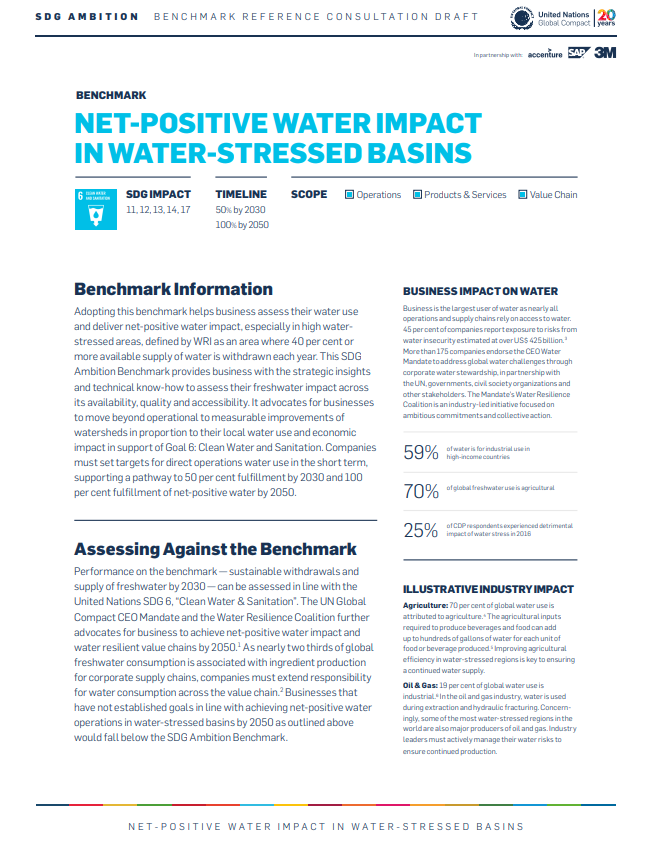
SDG Ambition Paper
The United Nations Global Compact SDG Ambition catalyzes innovative business strategies that significantly accelerate companies’ positive impact on the SDGs. Net Positive Water Impact is a cornerstone concept for accelerating progress on SDG6 – Water. Indeed, the dimensions of water stress addressed by NPWI (availability, quality and access) are anchored in UN Sustainable Development Goal 6: “Ensure availability and sustainable management of water and sanitation for all.”
Companies must raise their business ambition on water. Beginning with benchmarking performance and assessing the true business value of water, companies can evaluate their water impact and establish a roadmap for action. Achieving these ambitions requires NPWI business integration. The SDG 6 Ambition Paper breaks down each step of the process and maps out the pathways, goals, and processes of Key Design Decisions in the implementation of NPWI.
Blog: A Shared Ambition: The Net Positive Water Impact Journey
By Jason Morrison and André Ramalho
As climate change continues to exacerbate water risks, many companies have acknowledged the risks and opportunities that arise from the water-climate nexus. Some businesses are seeking a clear course of action to face these challenges. Others are going above and beyond – asking themselves how they can meaningfully contribute to improving water security more broadly, beyond the confines of their own companies.
A growing number of companies are now turning to one framework in particular to achieve that broader water ambition. . .