
[vc_row][vc_column][vc_column_text]
| Tool | A description of key elements of a Code of Conduct (CoC). In combination with the WSI operating principles, you can use this outline to establish a CoC for your WSI. |
| Related Key Activities | Clarify expectations of WSI behavior, development of an MoU. |
| Questions Addressed | How do we set out expectations for proper behavior of WSI participants? |
| Purpose | Outline expectations for behavior of WSI participants, thereby ensuring integrity issues related to conduct are taken into account, and removing the possibility of ethically dubious decision-making or action that might undermine the WSI:
|
| Possible Users | WSI participants |
| Level of Effort | The CoC should build on work completed in previous phases, therefore the CoC formalization should be a relatively simple, though significant preparatory work and can be completed in tandem with the development of an MoU and clarifying expectations of behavior. |
| WSI Phase | 2: Formalization. |
[/vc_column_text][/vc_column][/vc_row][vc_row][vc_column][vc_column_text]A Code of Conduct (CoC) is a “statement of principles and values that establishes a set of expectations and standards …, including minimal levels of compliance and disciplinary actions.” Most countries have a general CoC for public officials as well as relevant legislation on conflicts of interest. Where relevant, the WSI should draw on relevant legislation in the development of the CoC. Developing a shared understanding of integrity in a specific WSI is an essential exercise in stakeholder collaboration that serves to build trust among actors, share experiences and good practices, identify shared values, and clarify expectations. As a central reference, a CoC guides WSI participants when dealing with ethical dilemmas and grey areas in decision-making and engagement processes.[/vc_column_text][/vc_column][/vc_row][vc_row][vc_column][thim-heading title=”Guidance for implementation” line=””][vc_column_text]The diagram below lays out the key steps to undertake to develop a CoC. To get hesitant individuals on board for the development of a CoC and build confidence in it, participatory integrity risk management exercises (see Tool 1b) can be helpful. In such a workshop, participants establish the most relevant measures that should be implemented to ensure they are adequately managed.
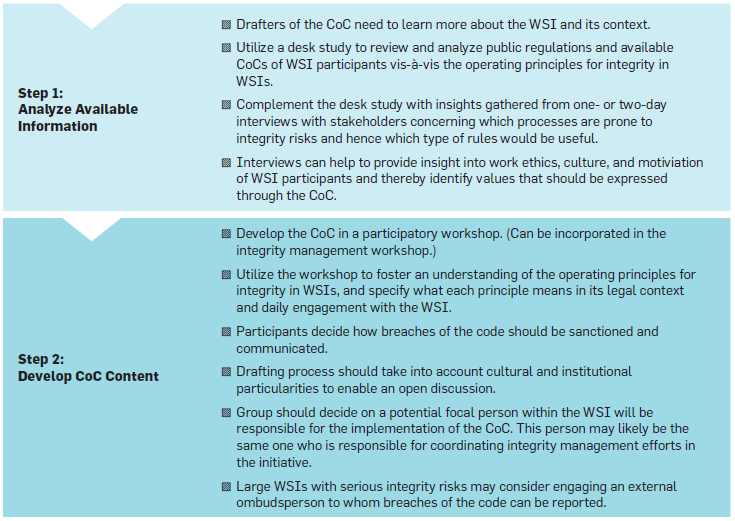
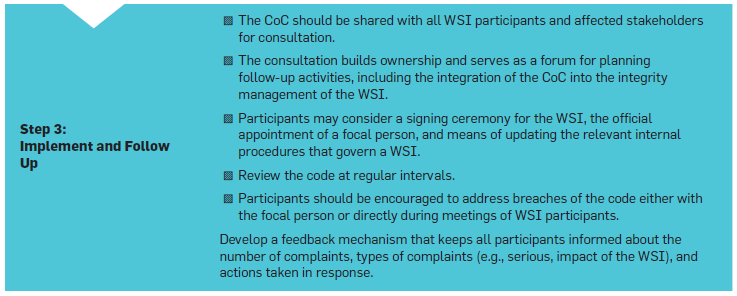 [/vc_column_text][/vc_column][/vc_row][vc_row][vc_column][vc_btn title=”Download Full PDF for more detail” size=”lg” align=”left” i_icon_fontawesome=”fa fa-download” add_icon=”true” link=”url:http%3A%2F%2Fbit.ly%2F2DFpuQc|||”][/vc_column][/vc_row]